When you make your Liir, you print three cards. Any two of them, with your name, bring everything back. They're your key, and we don't keep a copy.
No phone
01
Your phone is gone.
Dropped, stolen, dead in a lake. Today that usually means a week of support tickets, or never getting back in.
Read on this device
02
Your name, then two cards.
On a new phone or a friend's laptop, type your name and show two cards to the camera. The cards are read right there, on the device. Nothing secret crosses the internet.
Vault
Name
Mail
03
You're home.
Your vault opens right away, to read. The rest follows after a waiting period, which any device you're still signed in on can cut short or stop.
HOMEany 2 of 3
kai7mo
a safe place at home
Untitled (HOME)Paper and ink, 2026
Anonymous by design
Hang one on your wall. Nobody can tell whose it is.
A recovery card carries no name, no email and no address. It doesn't say whose Liir it opens, so a found card is a key with no door. Keep the three apart, where your life already is.
CARRIEDWith you.
HOMEAt home: framed on the wall, or in a drawer.
FARSomewhere else entirely: a bank box, a friend, family.
Your Liir name
Your name is private. Not a password.
Knowing your Liir name lets no one in: your key does that. But the name and two of your cards bring your Liir back, so Liir keeps it out of sight. It isn't printed on your cards, and Liir never shows it where someone else can see it. You hand out nameplates and doors instead.
Your Liir name · keep it to yourselftheultimatepotato@liir.net
Why your Liir name stays private
It's what you sign in with, and what your cards bring back. Pick one nobody would guess, and write it down somewhere that isn't with your cards.
If you forget it, your cards can't look it up. That's on purpose: a lookup would hand your name to anyone who found your cards.
A nameplate · hand it outdave-9337
Nameplates: the names you hand out
A nameplate is the name people see on your letters, like an alias at work: easy to say, and it's yours. You wear it over your private doors, and it isn't an email address, so a stranger can't write to it cold. It's optional. Without one, the people you write to see a random address for you.
Companies get an address of their own, one each, made in your mail. Close it, and their mail stops.
Every name has a mark
Your name, written in light.
Every Liir name has its own mark, drawn from its letters. No two names share one. Type a name and watch it draw.
Lowercase letters, numbers, and . _ - · drawn on this page, never sent
Try
The vault
Keep what you can't lose.
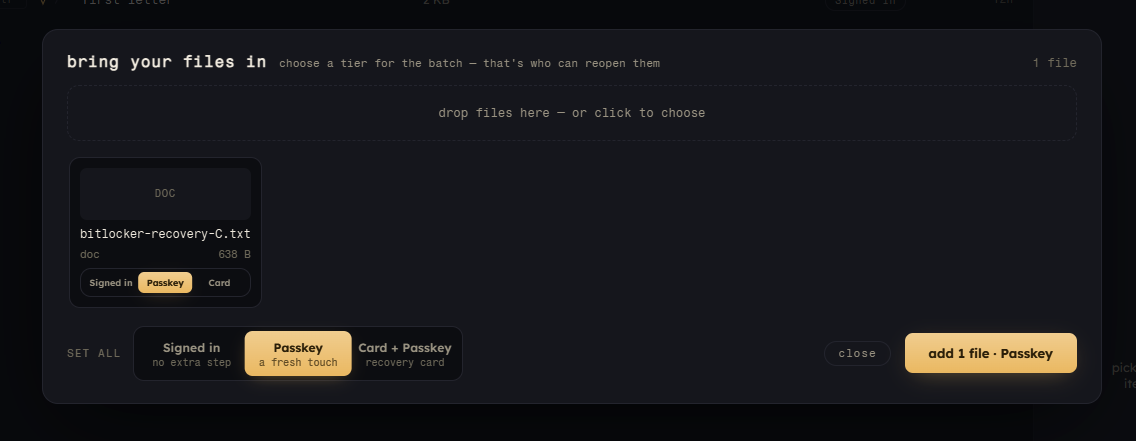
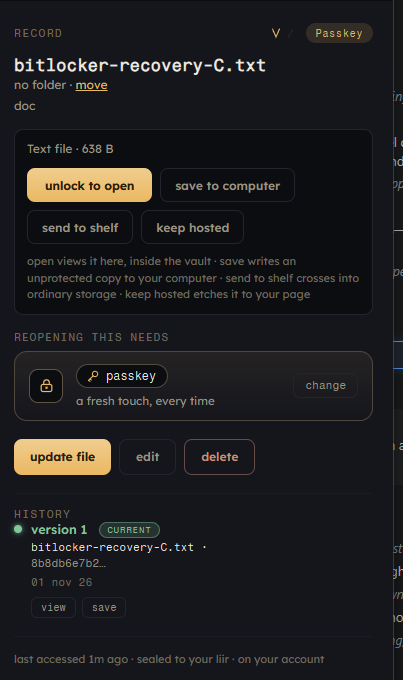
Photos, letters, papers, the keys to everything. Each one is sealed on your device with your passkey before it reaches Liir. You choose what it takes to open it again.
Reopening this needs
Private things. A fresh touch of your passkey, every time.
Signed inPasskeyRecovery card
Real screens from the vault, today.
Some things you only get once. The last message someone ever sent you is one of them.
The vault keeps letters, voicemails and photos, sealed.
Concept render
Cold Key Soon
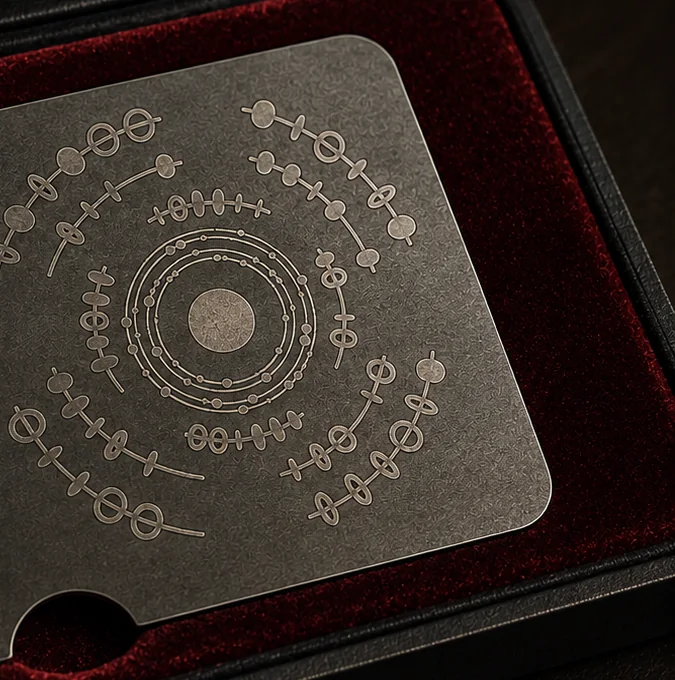
Your cards, in steel.
Your three recovery cards, made in bead-blasted steel and laid in a leather box on red velvet. Paper works. Steel is for the long run.
Cards
Three, in bead-blasted steel. Any two, with your name, bring you back.
Box
Black leather, with a velvet bed.
Names
None. Like the paper ones, a steel card doesn't say whose Liir it opens.
Not available yet. We'll say so here when it is.
On the way
What we're building next.
It isn't out yet, and it says so until it is.
Soon
Sign up anywhere in one touch.
A browser extension that gives every site an address of its own and fills your details into its forms when you press. If one of them starts getting spam, you'll see which site gave it out.
driftwood.shop/join
Driftwood
Create your account
Email
Continue
You're in.
Welcome to Driftwood.
Sign up with a fresh address
amber-cove-tide-40817@liir.net
Touch to continue
Liir filled in this site's own address
By design
The short versions.
The long ones live in the library, with the reasoning behind each.
Your vault, sealed on your device.
Your vault is sealed on your device with your passkey before it reaches Liir.
No reset desk.
Your name and your cards are the way back. There's no support line at Liir that hands your account to whoever calls.
No passwords.
You sign in with a passkey on your own device, so there's no password to reuse, leak, or type into a fake page.
Pricing
Start free. One plan when you want more.
Making your Liir costs nothing, with an invitation from someone who has one. The plan is $40 a year, billed once.